A Removed Google Review Came Back: What to Do
A review that disappears and later returns may be the original contribution restored by Google, a new post from the same person, or a similar post from another account. Those situations look alike in the review list but require different evidence.
Policy-based guidance, reviewed October 2026.
Quick answer
Compare the current review with your original screenshot and removal email. Check the reviewer account, direct review URL, wording, rating, attached media, and displayed date. A repost is new content and normally needs its own policy assessment. A restored original should be documented with the prior removal decision. Do not assume the old case automatically controls the current review.
First determine what actually returned
A restored contribution often retains its original age and account. A repost may show a newer date, a different direct URL, revised wording, or another account. Save both versions side by side.
The distinction matters because a repost is a new contribution, while a restoration may be connected to a prior moderation decision.
Keep the original removal evidence
Save Google’s decision email, case ID, screenshots, dates, and the policy issue that supported the first report. Do not rely on memory. The email and prior capture establish what was removed and when.
If the current version differs, identify the difference rather than describing it as identical.
Evidence to compare before reporting again
- Original and current screenshots
- Original and current direct review URLs
- Reviewer display name and profile
- Publication date and displayed age
- Exact wording, rating, and attached media
- Google removal or appeal email
- Original case or appeal ID
- Business records relevant to the current version
Reassess the current content under today’s facts
Google evaluates the content that is live now. A reviewer may remove the violating sentence and repost a permitted complaint. Conversely, a repost may repeat the same prohibited material or add a new privacy, harassment, or fake-engagement issue.
Report the current violation, not simply the reviewer’s persistence.
Document repeated posting as a pattern
Google’s policy prohibits repetitive content and content posted from multiple accounts by or at the request of one person. If the same text repeatedly appears, preserve the URLs, account names, dates, and matching language.
Do not claim the accounts are connected unless the evidence supports that conclusion.
Use the correct status route
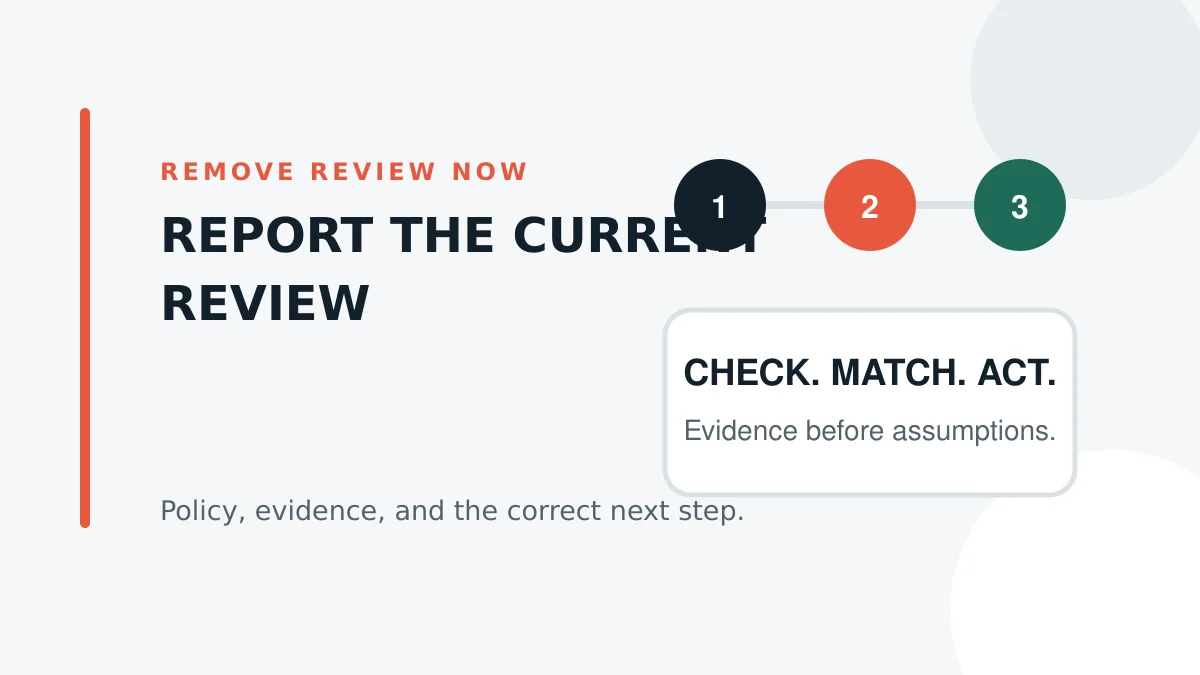
Open the Reviews Management Tool and look for the current review. If a report is still pending, wait for the decision. If Google found no violation and an appeal is available, use the one-time appeal. If the new review has never been reported, assess and report that contribution separately.
Avoid a public argument about the removal
Do not announce that Google previously removed the reviewer or threaten consequences in the owner response. A brief reply can state that the business cannot match the described experience and invites private contact, when that statement is accurate.
Keep moderation history and evidence out of the public exchange.
When professional case review helps
A returned review becomes complicated when several versions, accounts, profile merges, or previous decisions are involved. A timeline with one row per contribution can reveal whether the issue is restoration, reposting, duplication, or a separate new complaint.
Frequently asked questions
Reviews can reappear for several reasons. Confirm whether it is the same contribution or a new post before choosing a response.
No. Google controls each moderation decision and the current content may differ.
Use the policy category that accurately matches the current facts. Repeated identical content can be relevant evidence.
Preserve the account, wording, timing, and other reliable links. Do not state that two accounts belong to one person without support.
Use evidence that remains accurate, but update the file for the current URL, wording, date, and account.
Need a policy-based second look?
Send the review link and the facts you have. We will screen the case against Google policy and tell you when it appears worth pursuing.
Related Google review guides
Sources
Primary sources: Google Maps prohibited and restricted content policy and Google review reporting and appeal instructions. Policy wording and workflows were reviewed October 2026.