17 Reasons Google May Remove a Review
Google does not remove a review because it is harsh, unfair, or inconvenient. It may remove a review when the content or the behavior behind it violates a Maps policy. These 17 reasons give business owners a practical screening list before they report.
Policy-based guidance, reviewed September 2026.

Quick answer
The main reasons Google may remove a review include fake engagement, paid or coordinated activity, conflicts of interest, impersonation, harmful misinformation, threats, doxxing, hate speech, offensive allegations, profanity, explicit or violent content, restricted promotions, dangerous content, off-topic commentary, advertising, unclear text, and repetitive content. A report is stronger when it identifies one precise violation and preserves evidence.
1–4: Reviews that are not genuine or unbiased
1. No real experience: the rating is not based on an actual interaction. 2. Paid or incentivized content: money, discounts, free goods, or another benefit influenced the post. 3. Coordinated accounts: one person or organizer caused multiple accounts to post. 4. Conflict of interest: a current or former employee, contractor, vendor, competitor, or family connection creates bias.
These cases often need context outside the review text. Customer records, public employment information, duplicate wording, timing, and reviewer patterns can help. “We do not recognize the name” is a useful lead, but it is not the whole case.
5–8: Deception, impersonation, and harmful falsehoods
5. Impersonation: the contributor pretends to be another person, organization, or authoritative source. 6. Harmful misinformation: deceptive health, civic, or manipulated-event claims create meaningful harm. 7. Misrepresentation: the post distorts facts to scam users or unduly influence decisions. 8. Phishing or social engineering: the content tries to obtain confidential information or send users to malicious software.
A false display name by itself is not necessarily impersonation. The important question is whether the account is trying to mislead people about who is speaking or what authority it has.
Evidence checklist
- Complete screenshot and direct review URL
- Reviewer profile URL and visible contribution pattern
- Exact policy category supported by the content
- Customer, lead, booking, call, and transaction searches
- Employment, vendor, family, or competitor connection when relevant
- Threat, payment, solicitation, or coordination messages
- Attached photos or videos preserved separately
- A dated record of the report and Google decision

9–13: Harassment, privacy, and seriously inappropriate content
9. Specific threats: the content would reasonably cause fear for safety or well-being. 10. Doxxing or personal information: sensitive identifying, financial, medical, or private information is exposed without consent. 11. Hate speech: protected people or groups are attacked or dehumanized. 12. Offensive attacks: the review deliberately attacks people or makes unsubstantiated allegations of unethical or criminal behavior. 13. Obscenity or profanity: prohibited language is used to offend or intensify criticism.
Context matters. Google allows respectful descriptions of negative experiences, and it allows some inoffensive uses of words that might be profane elsewhere.
14–17: Content type, relevance, and repetition
14. Sexually explicit, adult-themed, violent, or dangerous material: the media or text crosses Google’s safety restrictions. 15. Restricted-product promotion: the post promotes controlled products with purchase links, contact information, or offers. 16. Off-topic or advertising content: political rants, unrelated commentary, promotions, phone numbers, or links do not describe the place experience. 17. Unclear or repetitive content: random characters or the same content posted repeatedly dilute useful information.
When a review includes both legitimate criticism and a possible violation, report the actual prohibited portion. Google is not there to decide the underlying customer dispute.
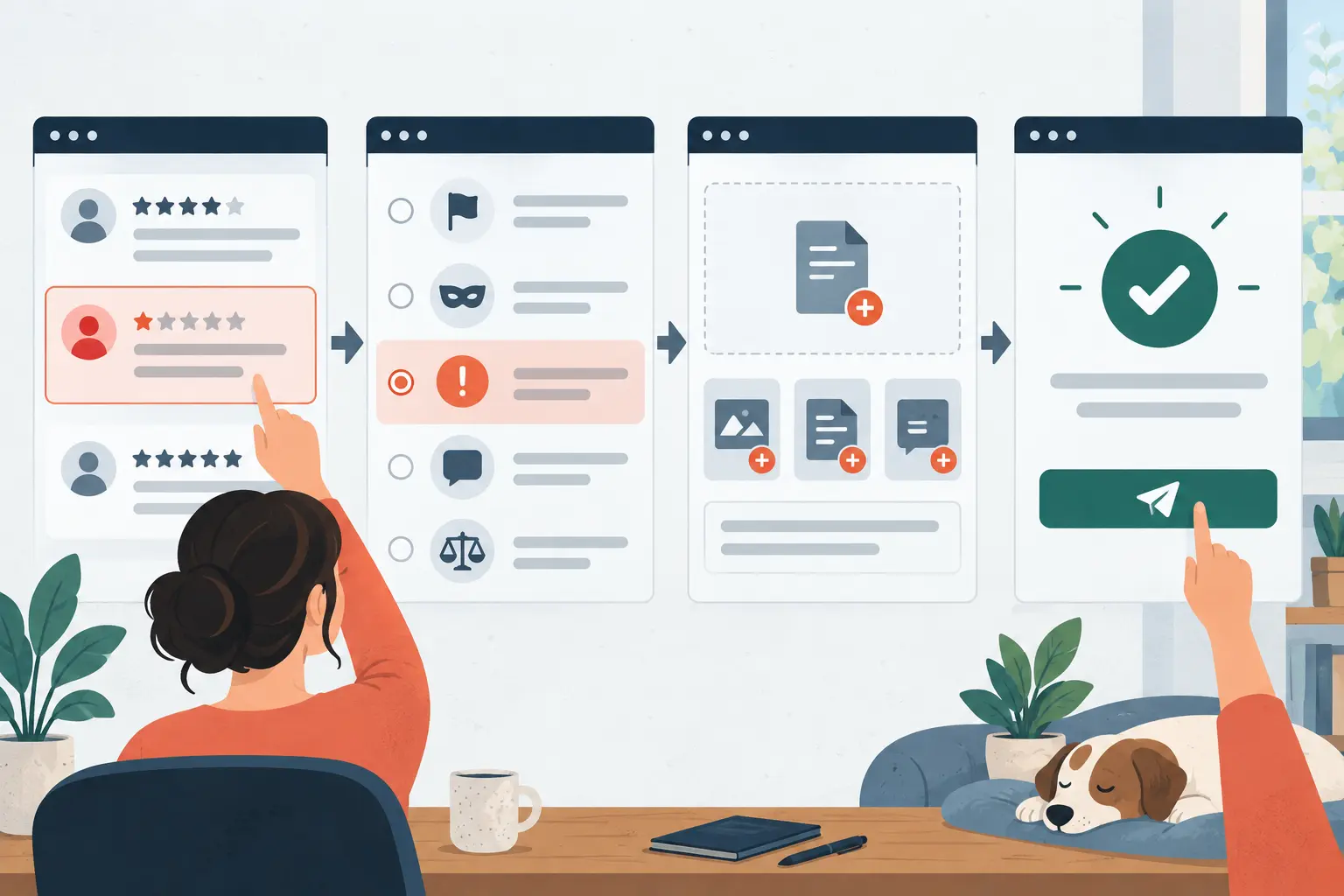
How to choose the strongest reporting reason
Read the review once for the business dispute and a second time for policy. Ignore whether the star rating feels deserved. Identify the narrowest rule supported by the text, media, account context, or verifiable relationship.
One clear policy path is usually better than a pile of theories. Moderation is not a raffle, and extra report buttons do not become evidence.
What evidence Google can evaluate
Preserve the complete review, direct URL, reviewer profile, date, star rating, attached media, and surrounding context. Add transaction searches, communications, employment or competitor connections, and pattern evidence only when relevant and lawfully obtained.
Google also considers signals businesses cannot see, including account information and patterns of behavior. Your role is to provide accurate context, not to invent certainty.
What normally will not qualify
A real customer saying the service was slow, expensive, rude, disappointing, or poor quality may remain even when the business strongly disagrees. A mistaken detail does not automatically create a policy violation.
If the review appears permitted, respond professionally and solve what can be solved. Honest screening saves time and keeps a weak report from becoming an even weaker appeal.
Frequently asked questions
Not automatically. The review must fit a Google policy category, or a separate legal process may apply. Explain the precise violation and supporting evidence.
Yes, if the content independently violates another rule, such as a specific threat, doxxing, hate speech, prohibited advertising, or obscene content.
Use the most accurate reason available in the reporting interface. A focused report is clearer than trying to make every category fit.
Google says an eligible review can receive a one-time appeal after an initial no-violation decision.
No. Google makes the final decision. The free audit is designed to separate plausible cases from negative reviews that are probably permitted.
Need a policy-based second look?
Send the review link and the evidence you already have. We will screen the case against Google policy and tell you whether it appears worth pursuing.
Related Google review guides
Sources
Primary sources: Google Maps prohibited and restricted content policy and Google review reporting and appeal instructions. Policy wording and workflows were reviewed September 2026.